The end of WoW?

Long time no post. Well, that’s because I’ve begun finishing my PhD. It’s time for the big rewrite, so that’ll probably mean (even) less blogging, and more working (if there’s a difference).

The reason I’m posting right now is that last Thursday, World of Warcraft’s next expansion pack, Wrath of the Lich King, was released. It marks the end of my ‘fieldwork’. I’ve been playing this game pretty much since the European release back in 2005 and it’s time to put it to rest for a bit. I might continue playing after I finish my PhD somewhere next summer, who knows…

I also wanted to bring up this news item from TwentyFifthNovember.com:

We are proud to declare that all WOTLK PVE raid content has now been cleared. This is both a moment of triumph and a cause for concern. The question in all our minds right now is if we could do this, how soon until the rest of the top guilds in the world clear all the raid content that WOTLK has to offer? Did Blizzard miscalculate in the tuning of these encounters? Or is this Blizzard folding under the weight of a large casual player base that demands to be on equal footing with end-game raiders?

No idea what this is all about? Well, TwentyFifthNovember is World of Warcraft’s top raiding guild (a merger of the famous Nihilum and SK Gaming teams) and they managed to beat all utmost difficult content of the new expansion pack in a mere 65 hours after it was released. That means all the biggest, hardest bosses in the game – Kel’Thuzad, Sartharion and Malygos – defeated in less than 3 days.

To put this into perspective: this used to take weeks, even months of hard training, learning and dedication. These guys manages to do it largely with their old gear from the last expansion pack, and while they hadn’t even reached level 80 yet (the newest top level).

Sure, they are the best skilled players around, but still, this is a strange or at least fascinating situation. Is Blizzard indeed ‘folding under the weight of a large casual player base’, the ultimate fear of all hardcore players.

Maybe. But is this a bad thing?

A little update…

For those interested, they have published the report slash paper I wrote about the recent PICNIC’08 event. It’s titled ‘The Future of Virtual Worlds, or: how do we make money from these things’ and can be found here. I think the title pretty much speaks for itself.

This week I’ll be heading to Copenhagen for what probably will be my last conference visit before the final (year-long) sprint to finish my PhD. It’s the IR 9.0: Rethinking Communities, Rethinking Place conference organized by the Association of Internet Researchers. I’m giving a small talk about the use of walkthroughs and the practice of speedrunning in, yes, World of Warcraft. It’s part of a panel of World of Warcraft researchers though whom I all know very well through my participation in The Truants. I’m really looking forward to that!

Spot the real Warcraft.

I know, it’s another World of Warcraft post. This news item was just too interesting to pass up.

In a presentation on ‘emerging media: its effects on organisations’ (powerpoint here), the US based National Defence University’s Dr. Dwight Toavs used World of Warcraft for a fictional case of terrorist plotting through virtual worlds. The terrorist are using WoW maps and lingo for organising an attack on the White House.

According to WiReD, who wrote a nice article on this amazing piece of terrorism scare, Toavs ‘believes that spies will have to spend more time in virtual worlds like WoW, if they want to have a hope of keeping tabs on what goes on inside ’em.’

We’ve heard about stories like these before. That it could actually happen (I mean, if I was a smart terrorist…) or that secret agents are maybe scouring through my in-game talk, I’m not sure which one is scarier.

Game adaptations and PICNIC

Busy week ahead. I will be presenting during the Third Annual Association of Literature on Screen Conference in Amsterdam. My talk is called ‘Tales of the Past: Performance-based Adaptation in World of Warcraft Machinima’ and is, as one would probably expect, part of the ‘adapting video games’ panel.

What I won’t be doing is discussing the growing number of terrible game-to-screen adaptations made by the likes of Uwe Boll. My paper will focus on how to retain player agency and performance while adapting game to film and will, as a result, discuss player created films, more specifically machinima. Here, play is adapted to film, not just a story.

My case study, the impressively large-scale machinima production Tales of the Past III, blends existing storylines and characters from World of Warcraft’s Azerothian lore with those of the players involved. In a game where you cannot have any lasting impact on the fictional world, a homemade adaptation like this one empowers players to establish themselves as true heroes in Warcraft’s grand narrative.

This conference, pure humanities academia, is as far removed from the marketplace as you can get. The other conference I will be visiting is the opposite. PICNIC is an annual, large-scale, new media oriented event and, quoting their site, ‘brings together and disseminates the ideas and knowledge of the world’s best creators and innovators.’

Part of ‘Enquiring Minds’, a group of new media researchers invited to PICNIC, I’ll be looking at all the new developments and ideas in the new media marketplace, with people from companies like Philips and Google giving presentations. Glancing at the program, I’ll be bombarded with a whole lot of utopian celebrations of ‘we’, the creative masses. The inclusion of Aaron Koblin’s The Sheep Market made me chuckle.

The Voice became silent.

Last Monday, one of the movie industry’s most beloved celebrities died. His name is Don LaFontaine. Never heard of the guy? Well, you will instantly know him when you hear him. He’s the ‘In a world…’ voice-over guy from many hundreds of film trailers of the last decades.

This news made me think of a little paper I just wrote dealing with the concept of paratext, those textual elements giving meaning to all the information accompanying the main text of a media object (like the preface, table of contents and index of a book). They form ‘thresholds of interpretation’ as Genette puts it, potentially controlling the way a person reads, views or, in the case of games, plays the main text.

While the paper dealt with strategy guides for games (following Mia Consalvo’s excellent work on the topic), I just realised the paratextual power of LaFontaine’s legacy .

The carefully chosen words he uttered (nay, boomed) into his microphone, often in the cheesiest semi-poetic manners possible, may be pure marketing, they exist in a totally different textual plane than the rest of the film. They are not part of a film’s diegesis (or even non-diegesis), but nevertheless form the first threshold many viewers pass before encountering the film itself.

For the movie industry, his voice was all-powerful, an almost God-like tool to steer the audience to the box office. As this fun short with LaFontaine and his colleagues shows, it demands respect.

Here’s a nice article honouring LaFontaine’s work, including a nice little documentary in which you can actually see the man himself talk about his work. The Don will be missed.

Lovely spam, wonderful spam

Well this is fun: it took less than a day for World of Warcraft spambots to find yesterday’s post.

Look at that post’s comments and you will find a friendly person informing us where to go for the best WoW cheats, dupes, bots and walkthroughs. His/her own site appears to be a bizarre mix of more spam and rondomly generated ‘poetry’. It’s a splog, as such blogs have come to be known.

World of Warcraft spam is everywhere!

Bringing even more friends (and money) to Azeroth

While the practice of luring in new subscribers through existing subscribers by giving the latter freebies for doing so has been around for ages in the world of magazine publishing. The recent announcement by Blizzard to do the same with World of Warcraft is nevertheless raising eyebrows among the player community.


This is what Blizzard is offering (the particular rules and conditions can be found in their FAQ):

Our new Recruit-a-Friend offer rewards you even more for bringing your friends to Azeroth and, what’s more, they can get some great in-game benefits too!

For each friend you invite you could get:

– An exclusive ZHEVRA in-game mount when your friend pays for 60 days of game time.

– 30 Days of FREE WoW gametime when your friend pays for 30 days of game time.


Also, from the moment your friend creates a character and starts adventuring with you, both of you will receive these additional in-game benefits:


– You and your friend will earn triple the experience when grouped together!

– For every two levels of experience your friend earns, they can grant one level of experience to any one of your characters of lower level than your friend.

-You and your friend will have the ability to summon each other from any point in the world.


Business-wise this is a brilliant recruitment strategy: let players bring in more players, give them virtual rewards which don’t cost a thing and reap the benefits. Folks who always wanted to get their significant other hooked, multi-boxers and Chinese gold farmers aside, a lot of players on forums like this one think otherwise are now flaming Blizzard for being unethical, greedy money grabbers.


To quote one player: ‘The fact of the matter is this: you spend more money, and you have an advantage in the real game. This is fundamentally different from any promotion Blizzard has ever had. It’s also a sign that Blizzard has lost its scruples about abusing this business model.’


I would say it took them rather long to lose their ‘scruples’. With Blizzard being the 2nd largest publishing company in the games industry after its $18bn merger with Vivendi/Activision, and World of Warcraft being one of the main cash cows, seeing the forces of capitalism enter this virtual world is no surprise at all. It may hurt a bit, but it was inevitable And, yes, resistance is futile.


I sure wouldn’t mind getting one of those Zhevra’s though. Anyone wanna play WoW?


To unlock or not to unlock…

I finally started playing Super Smash Bros. Brawl recently, and I have to say it’s an awesome game. The more I play it, the less chaotic it is and the slicker and more productive my fighting skills become. Problem is: I don’t want to be better at this game.

That seems like a strange thing to say when dealing with a game, especially a game I just admitted to liking a lot. Fact is, Super Smash Bros. Brawl is a multi-player game and this is the main reason I bought it. I want to play this game with (‘up to’) three of my friends, not alone. As most of these friends don’t have a Wii with SSBB on it, I simply don’t want to train myself to such a point where competing is not fun anymore for those involved.

Why not stop playing alone then? Like with many games in the beat-‘m-up genre, a large part of the game’s attraction is unlocking hidden characters to play with. That’s not just the completist in me. These characters aren’t just cosmetic rewards. They all have their own unique and often exuberant fighting styles. So, I want Sonic, Solid Snake, Falco, Lucario. I need Ganondorf, Luigi, Mr. Game & Watch and Captain Falco.

Problem is: to unlock them I need to spend hours and hours on single-player content. Here’s what I need to do to unlock Jigglypuff, taken from an unlock guide on gamefaqs:

  1. Play 350 Brawls
  2. Complete SSE and then clear Events 1-20
  3. Complete SSE and then Find Jigglypuff in the Swamp stage (He is in a Red Door, just enter them all)

Admittedly, this character is one of the hardest to get access too, and there’s nothing wrong with rewarding perseverance and skill at all. The best/most dedicated players should get some kudos from the game. It’s all part of the whole challenge/reward curve of proper game design.

This completely logical reward system does however interfere with the casual gaming approach I’d like to take with this particular title. The either/or situation is a recurring one I find myself in with fighting games. Novice and expert players simply don’t mix well in this genre like they do in, say, Guitar Hero or Mario Kart.

Unlockable features, especially playable characters, remain tricky game design decisions in this industry. If you don’t want to or cannot invest the time and energy to unlock them, you are missing out on content you’ve already paid for.

I guess it’s back to single-player again for me. I might get better in SSBB than I (or my friends) would like. But who doesn’t want to fight with one’s own R.O.B..

WWI 2008: notes from a brand fest

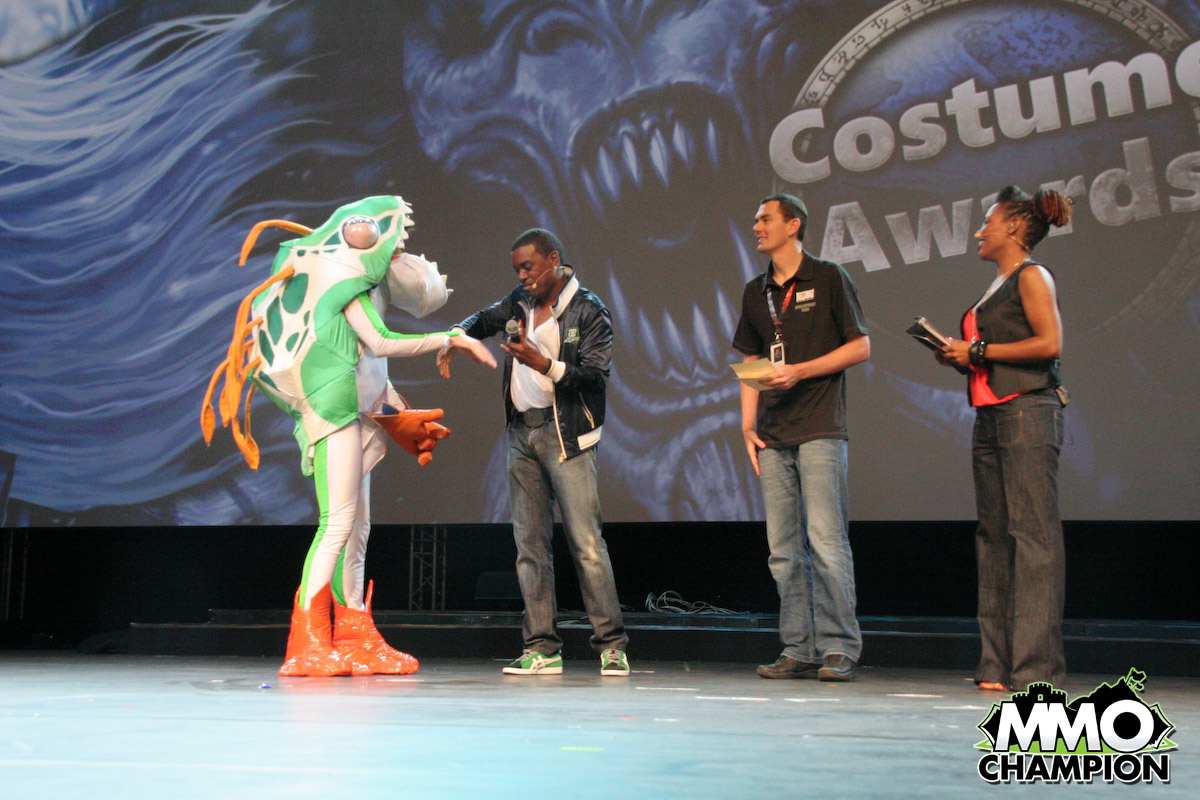
The Blizzard Worldwide Invitational I visited last weekend certainly was a unique experience. For those of you unaware of what the WWI is, it’s basically a yearly celebration of all things Blizzard, ie. the Warcraft, Starcraft and Diablo videogame series, for non-US players (as those have their own Blizzcon). Thousands of eager fans swarmed Paris in search of Blizzard developers, playable unreleased games, scoops and, of course, goodie bags. I gleefully joined them.

The whole thing started with a giant opening ceremony. The most fascinating part about this ceremony wasn’t that the hosts whipped the crowd into a cheering frenzy for the presence of Blizzard’s ‘superstars’. That was to be expected. No, it was because these ‘superstars’ included not only the designers and founders of the company but also the heads of PR, marketing and, yes, even global finance. So here was a crowd of thousands, cheering for those who did not make the games and virtual worlds they adore, but for those whose job it is to make a lot of money out of this love. In all fairness, most of the crowd didn’t even know these ‘suits’ (or didn’t hear their names being called out due to the deafening music) but cheer they did. Hurray for the money!

A fellow researcher also present at the event sighed at one point that, in retrospect, the Sony organised Everquest events of yesteryear where far better organised – as a meeting point for community members that is. At these events, she told me, players all wore tags with their server and guild names on it, and the event nourished these sub-communities to meet and greet. No such things were organised at WWI. In Blizzard’s defense, this event was not just for World of Warcraft players (in contrast to the Everquest events). But it does fit WoW’s image of being allabout playing alone together quit well.

The MMORPG genre has ‘grown up’ commercially. But it seems to have lost a lot of its tight community feeling.

Sub-communities a plenty though, and all were looking for acknowledgment with the Blizzard dev’s. Raiders where present to cheer for everything re-establishing their hardcore-ness (for example when, during a Q&A session, someone asked when Blizzard would solve the problem of the large influx of ‘newbs’). PvP’ers sat on the edge of their seats when class balance was discussed (how dare they/they should give [insert random class] a more powerful [insert random spell]). RP’ers showed up in full costume, proudly defying ridicule (murloc’s ftw!). There was even a brave furrie – he must have been one! – who asked if druids could please get gendered versions of their animal forms (short Blizzard answer: no).

All groups had to deal with Blizzard developers stressing that the upcoming World of Warcraft expansion pack Wrath of the Lich King is going to become ‘not easier, but more accessible’, with ‘less barriers’ and ‘reduced complexity’ (one might suspect these terms now form the official developer’s mantra, as they were heard many, many times). Some cheered, some winced, some took their opinions to the web to cause yet another flame war between casuals and hardcore players.

All I can say is that it’s a logical step that Blizzard is supporting the more casual approach to World of Warcraft play. By far the largest part of the player base can be considered ‘casual’ players.


On the other hand, it’s also usually this group who cause the feeling of a fragmented, individualised community. You can’t really blame casual players though; not everyone wants a ‘second life’. WotLK’s design approach simply looks like the future of the genre in its popular form. We will have to wait another few months for the expansion pack to come out to see if it’s really that bad/good for the community as a whole.

Oh, and the game they were hinting at in the days before WWI? It was Diabo III. When they thought it couldn’t get worse, here’s another title for moral crusader’s on game addiction and violence to start worrying about. Hell, it must be the devil’s work!

And the new Blizzard game is…

In a few days from now, I’ll be on my way to Paris for the 2008 Blizzard Entertainment Worldwide Invitational. Allthough they will have all kinds of events around several Blizzard games (most notably Starcraft II), the reason I’m going is the new World of Warcraft expansion pack called Wrath of the Lich King. Can’t wait to try that out and hear the developers talk about the choices made in producing this next step in WoW evolution.

Today though, Blizzard decided to tease the masses (including me!) with the splash screen as shown below . It’s plastered on lots of Blizzard sites and hints at a big game announcement being made at the event. Due to the ice and all, it could just be Wrath of the Lich King after all (beta launch or release date announcements?). Or will they be unveiling the long awaited Diablo III? World of Starcraft? Starcraft: Ghost after all? Or entirely new IP? Or maybe, as many hope with me, a new Lost Vikings game! I’ll keep you posted!